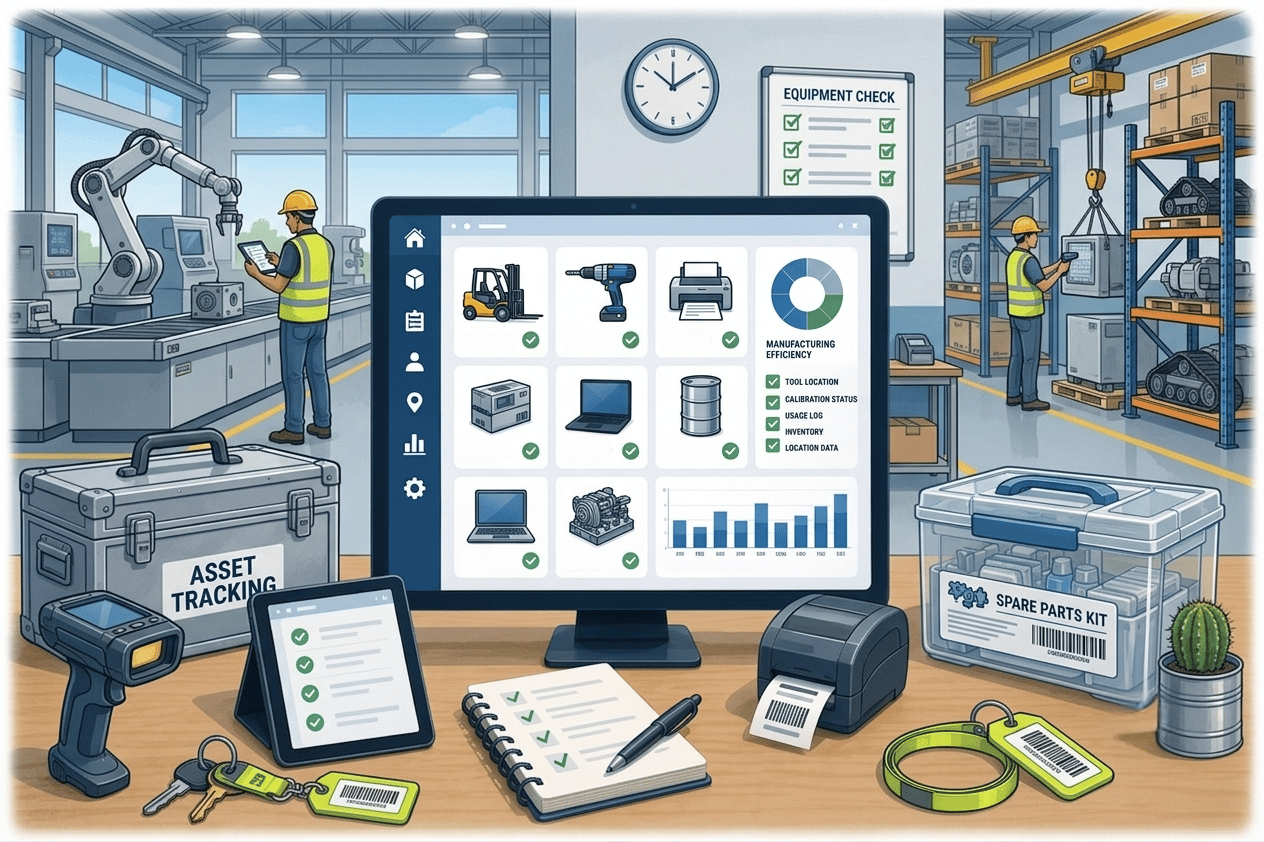
Manufacturing and warehousing environments are built around efficiency. Shifts run to tight schedules, production targets are fixed, and any time lost to something going wrong is time that's very hard to claw back. That pressure is well understood on the production side. Where it tends to get overlooked is in how assets are tracked.
Tools go missing between shifts. Specialist equipment ends up in the wrong area of a warehouse. Machinery keys are left with the wrong team. In isolation, each of those things is a minor issue. Add them up across a week on a busy site, and the cumulative cost in lost time and disrupted workflow is significant.
The shift handover problem
Shift handovers are one of the biggest pressure points for asset tracking in manufacturing. When one team finishes and another starts, there is rarely a clean process for confirming what is where. Tools and equipment that were fine at the end of one shift are assumed to be in place at the start of the next, without anyone actually checking.
Over time this creates an asset register, whether formal or informal, that does not reflect reality. Things are assumed to be where they have always been, right up until someone needs them and they are not there. A digital check-in and check-out system at handover takes seconds per item and eliminates that uncertainty entirely.
Tool tracking on the warehouse floor
Large warehouses and manufacturing sites often have tools and equipment spread across multiple areas, used by multiple teams. Without a clear system for tracking what belongs where and who is responsible for it, tools migrate. They get borrowed, moved to another section, and never make their way back. Replacements get ordered because nobody can find the original, which already exists somewhere on site.
A proper facilities asset management system gives you visibility across all of that in one place. Every tool has a record. Every movement is logged. When something cannot be found, there is a clear trail to follow rather than a site-wide search.
Maintenance and servicing records
Manufacturing equipment requires regular maintenance, and in many cases there are regulatory or insurance requirements tied to that. Keeping on top of service schedules manually, across a wide range of machinery and equipment, is difficult. Things slip. Checks get missed. And when an audit or inspection comes around, piecing together a maintenance history from paper records and spreadsheets is time consuming and error prone.
An asset management system that logs maintenance activity against each asset means your service history is always up to date and easy to access. Our guide to asset compliance and auditing covers how this ties into inspection readiness more broadly.
Key control across a large site
Manufacturing and warehouse sites often have significant key management requirements. Machinery keys, access keys to restricted storage areas, forklift keys, keys to electrical cabinets. Knowing exactly who has what, and having a full history of access, matters both for day-to-day operations and for security and compliance purposes.
Our security and key tracking solution is built around exactly this, giving site managers a live view of key allocation and a timestamped log of every movement without relying on a paper sign-out sheet that gets lost or ignored.
Managing assets across multiple sites
For businesses operating across more than one site, the challenge scales up quickly. Equipment gets moved between locations. Accountability becomes harder to establish. Trying to maintain a consistent picture of what is where across multiple warehouses or manufacturing plants is almost impossible without a centralised system.
AssetControl.cloud is built to handle multi-site operations, with assets, users, and locations all structured to reflect how your business actually runs. The right people see the right assets, and nothing falls into the gap between sites.
Where to start
If your site is still relying on clipboards and spreadsheets to track tools, equipment, and keys, our free asset tracking checklist is a useful place to start. It helps you identify where the gaps are before committing to anything.
When you are ready to see what a proper system looks like in practice, book a free demo and we will walk you through AssetControl.cloud. You can also view our pricing to see what is included at each level.