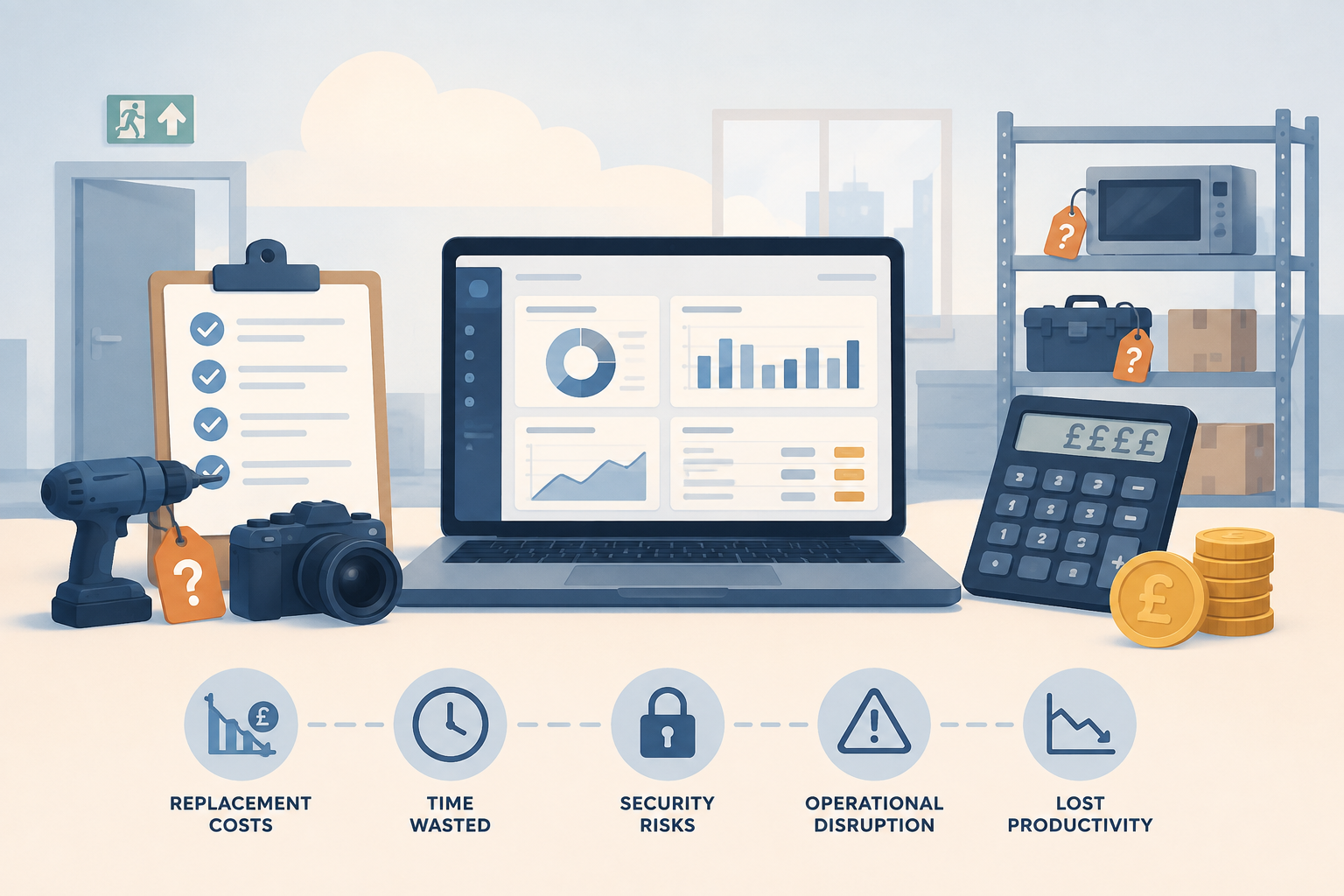
Most businesses have a rough sense that poor asset tracking causes problems. Things go missing. Time gets wasted. But the actual cost rarely gets calculated, because it does not show up neatly in one place. It is spread across replacement purchases, staff time, delayed work, failed audits, and security incidents. None of it is dramatic on its own. All of it adds up.
Here is a clear picture of what untracked assets actually cost a business, and why the problem is almost always bigger than it looks.
Replacing things you already own
This is the most straightforward cost and the one most businesses underestimate. When an asset cannot be found, the default response is often to buy a replacement rather than spend time searching. A spare set of keys gets cut. A replacement tool gets ordered. A new device gets procured because nobody can confirm where the old one is.
Each of these purchases feels justified at the time. It is only when you look across a year and add up how many replacement purchases were made for items that were simply untracked that the true figure becomes clear. For businesses managing large volumes of equipment, this number can be significant.
Staff time spent searching
Time spent looking for assets is time not spent on anything productive. A ten-minute search for a missing key at the start of a shift might not feel costly. Multiply that across a team of ten, five days a week, and it becomes a meaningful number. For businesses where work cannot begin until the right equipment or access is in place, the knock-on effect extends beyond the search itself.
A proper asset management system removes this entirely. The location and status of every asset is visible at a glance. Nobody needs to search for anything.
Security incidents and their aftermath
Untracked keys are a security risk that carries a cost well beyond the price of the key itself. When a key cannot be accounted for, you do not know who has it or where it has been. In the worst case, that means replacing locks, rekeying access systems, and in some environments, notifying relevant parties about a potential security breach.
The cost of a single untracked master key going missing can run into thousands once you factor in the remediation work. Our security and key tracking solution is built specifically to prevent this, giving you a full history of every key movement so nothing is ever unaccounted for.
Assets walking out the door
Staff turnover creates a consistent leak in asset inventories. Laptops, phones, keys, and equipment leave with people who no longer work for the business, often without anyone noticing until the next time that item is needed. Without a record of what was issued to each person, recovery is difficult and losses tend to be written off rather than pursued.
This is particularly acute in sectors with high turnover. Our post on what happens to assets when an employee leaves covers this in more detail, including how a simple check-out record at onboarding makes offboarding significantly cleaner.
Missed maintenance and early replacement
Assets that are not tracked are also assets that are not maintained on schedule. When there is no system logging when something was last serviced, maintenance either gets missed entirely or gets done inconsistently. The result is equipment that fails sooner than it should, or machinery that goes out of service at exactly the wrong moment.
Proper facilities asset management includes maintenance scheduling as standard. Service history is logged against each asset, so nothing slips through and replacement decisions are based on actual condition rather than guesswork.
Audit failures and compliance costs
For businesses that operate in regulated environments, the cost of poor asset records extends into compliance. Audits that reveal gaps in tracking, missing maintenance records, or unaccounted-for equipment can result in formal findings, remediation costs, and in some cases, operational restrictions while issues are resolved.
Even for businesses without formal regulatory requirements, internal audits and insurance assessments rely on accurate records. Our guide to asset compliance and auditing outlines what good practice looks like and how to get there without a significant amount of upfront work.
What the fix actually costs
The irony is that the cost of a proper asset tracking system is almost always a fraction of the costs it removes. When you add up replacement purchases, staff time, security incidents, and compliance issues, the case for investing in better tracking becomes straightforward.
If you want to see where your business currently stands, our free asset tracking checklist is a good starting point. Or if you are ready to see AssetControl.cloud in action, book a free demo and we will walk you through it. You can also view our pricing to see what is included.