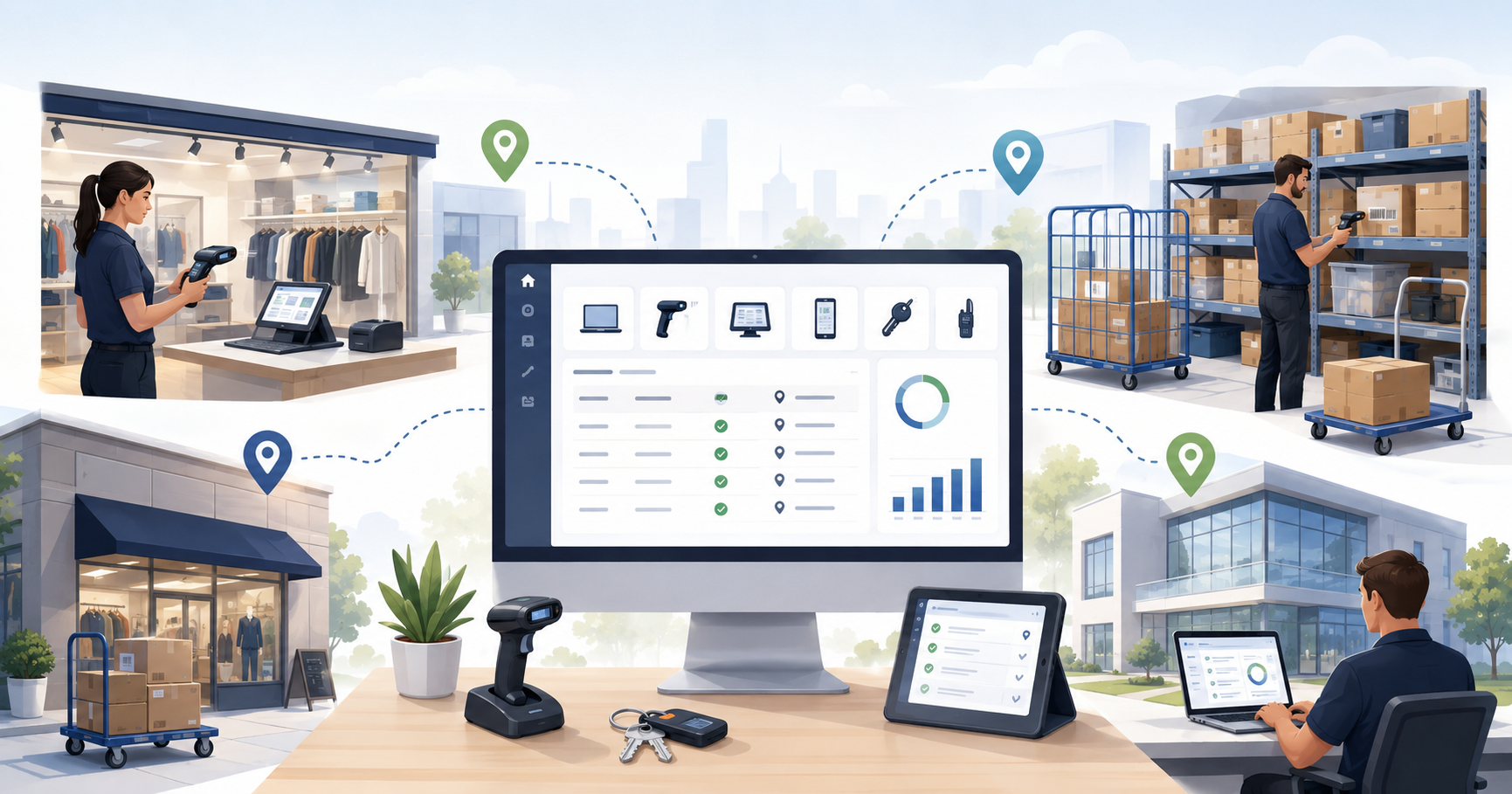
Retail businesses deal with a specific kind of asset management problem. Equipment gets moved between stores, shared resources end up at the wrong location, and with staff turning over regularly, the question of who has what becomes difficult to answer. The bigger the operation, and the more sites involved, the harder it gets to maintain a clear picture.
Most retail businesses manage this with a mix of informal systems. A manager keeps a mental note of where the handheld scanner is. A key gets passed between staff without being logged. A piece of equipment goes out for a store visit and takes three weeks to make its way back. None of it feels like a crisis on its own, but the cumulative effect on time and resources adds up quickly.
The multi-site visibility gap
For businesses operating across more than one location, the fundamental problem is visibility. You cannot manage what you cannot see. When assets are tracked site by site, using different systems or no system at all, nobody has a complete picture of what the business actually owns and where it currently is.
That matters when equipment needs to be moved between stores, when a location is being audited, or when something goes missing a,nd the trail is cold before anyone realises. A centralised asset management system gives everyone with the right access a consistent view across all locations, so decisions can be made with accurate information rather than educated guesses.
Equipment that moves between locations
In retail, certain assets naturally move around. Promotional materials, display equipment, handheld devices, till hardware, tools for store fitouts. When those items are tracked properly, the movement is documented and the current location is always known. When they are not, they disappear into the gap between sites and the first anyone hears about it is when the item is needed somewhere it no longer is.
Our facilities asset management approach is built around exactly this kind of shared and mobile asset, giving you a log of every movement and a clear current status for every item, regardless of which location it is currently at.
Key management across stores
Key control is a consistent pressure point for retail operators. Store keys, office keys, keys to cash handling areas, keys to stockrooms. In a single location, it is manageable. Across multiple sites, with staff changing regularly, it quickly becomes a security concern as much as an operational one.
Knowing exactly which keys exist, who holds them, and when they were last signed out gives you genuine control rather than assumption. Our security and key tracking solution provides a full timestamped history of every key movement, so access is always accountable, and nothing is left to memory or a paper log that may not be kept up to date.
Staff turnover and asset recovery
Retail has one of the highest staff turnover rates of any sector. Every time a member of staff leaves, there is a risk that assets leave with them. Keys, devices, uniforms, equipment. Without a clear record of what was issued, recovery is difficult and losses often go unnoticed until the next time that item is needed.
Logging what is issued to each staff member at the start of their employment makes offboarding straightforward. There is no guesswork involved. You know exactly what needs to come back, and the record is there to support that conversation if it is needed. For more on this, our post on what happens to assets when an employee leaves covers the problem in detail.
IT hardware across the business
Beyond physical equipment and keys, retail businesses manage a growing amount of IT hardware. Tablets for stock management, handheld scanners, tills and card machines, and laptops are used by management across sites. Keeping track of where those devices are and who is responsible for them is a genuine challenge, particularly when they move between locations regularly.
Our IT asset tracking page covers how to maintain visibility over devices across multiple locations, including assignment records, location history, and lifecycle management.
Making audit time less painful
Retail businesses are subject to regular audits, whether internal stock checks, external compliance reviews, or insurance assessments. Having a clean and up-to-date asset register makes those significantly easier. Everything is logged, timestamped, and attributable to a user. There is no scramble to piece together records before an inspection.
Our guide to asset compliance and auditing is worth a read if this is something your business struggles with currently.
Getting started
If you manage assets across more than one retail site and are still relying on informal systems to keep track of them, our free asset tracking checklist is a practical starting point. It helps you identify exactly where the gaps are before you do anything else.
When you are ready to see what a proper system looks like, book a free demo, and we will walk you through AssetControl.cloud. You can also view our pricing to see what is included at each level.