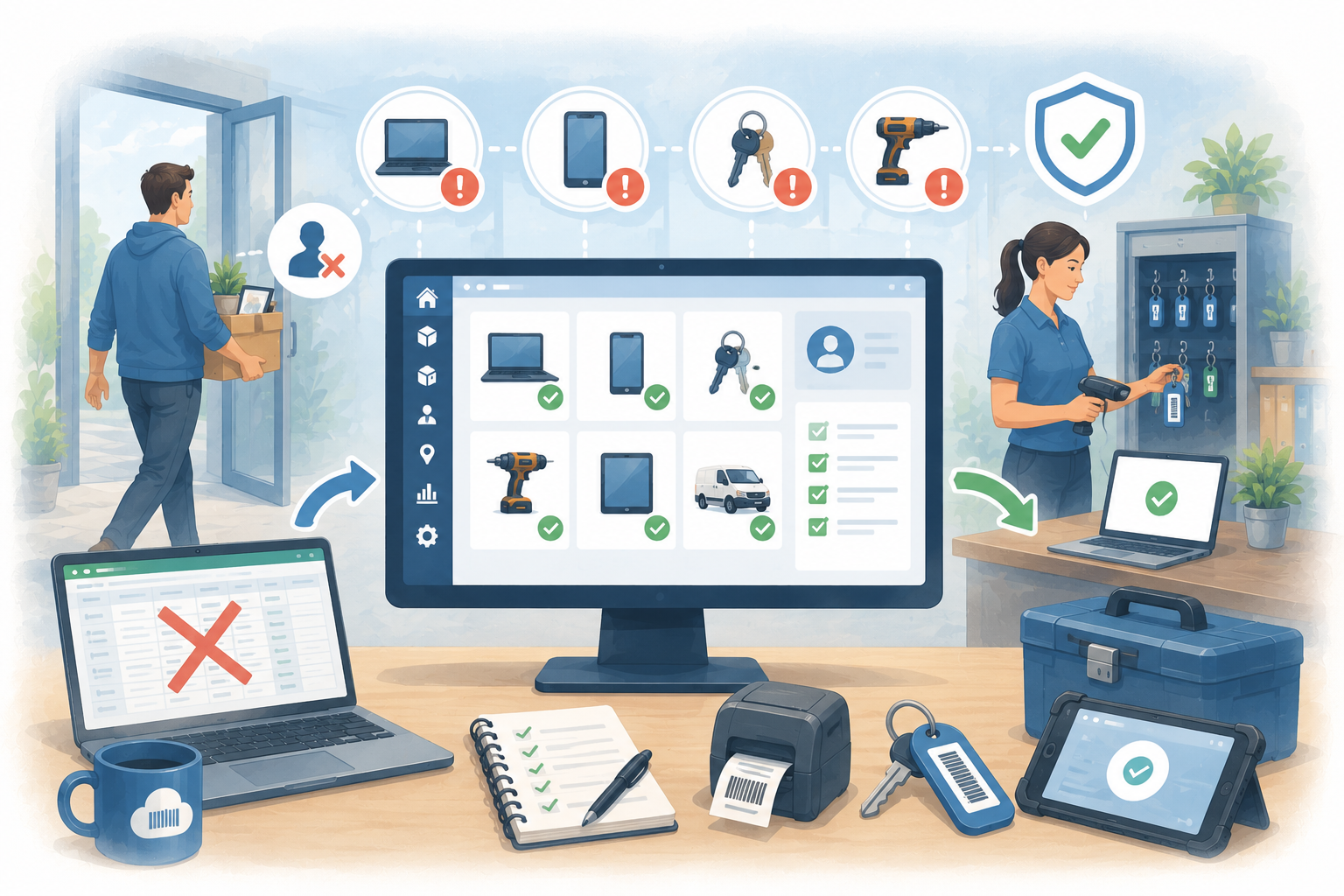
For most businesses, staff offboarding follows a familiar process.
Someone hands in their notice. HR updates the paperwork. IT disables accounts and removes access permissions. Managers arrange cover, handovers take place, and someone usually remembers to organise a leaving card before the employee finishes up.
But while digital access is often locked down quickly, physical assets are another story entirely.
A laptop goes home and never comes back. A mobile phone sits forgotten in a drawer. A set of keys disappears into a coat pocket and quietly stays there long after the employee has left the business.
These situations happen far more often than many organisations realise — and the costs associated with them can build surprisingly quickly.
The Gap in Most Offboarding Processes
Most companies already have some form of offboarding checklist in place. Email accounts are disabled, payroll is updated, and access to systems is removed. These tasks tend to be prioritised because the risks are immediate and obvious.
Physical assets, however, often fall into a grey area.
That’s usually because there isn’t a single, reliable record showing exactly what has been issued to each employee over time.
A member of staff may have received:
- A laptop during onboarding
- A mobile phone several months later
- Additional equipment after changing roles
- Keys or access fobs from facilities
- Shared tools or specialist devices for specific projects
In many businesses, these assets are handed out by different departments at different times, with little consistency in how they are recorded.
By the time an employee leaves, nobody is entirely certain what needs to be returned.
Instead of a clear process, businesses are left relying on memory, old emails, spreadsheets, or informal handovers between departments. That uncertainty is where assets begin to disappear.
Missing Assets Cost More Than You Think
The obvious issue is replacement cost.
Replacing laptops, phones, tablets, radios, tools, or specialist equipment quickly becomes expensive — particularly when losses happen repeatedly across a growing team.
But the financial impact goes beyond the value of the asset itself.
Keys and Access Control Create Security Risks
Keys are one of the biggest overlooked risks during offboarding.
If a business cannot confidently confirm who still holds keys, access fobs, or entry cards, it creates a serious security concern. The cost of replacing a physical key might be small, but the consequences of uncontrolled building access are much larger.
In some cases, businesses end up:
- Replacing locks unnecessarily
- Reissuing multiple keys across departments
- Restricting access temporarily while issues are resolved
- Spending management time investigating missing items
The real cost becomes operational disruption and reduced security confidence.
The Time Drain Nobody Tracks
One of the biggest hidden costs of poor asset management is the amount of time it wastes internally.
When there’s no clear audit trail, managers and administrators are forced to piece together information manually:
- Checking spreadsheets
- Searching through emails
- Asking colleagues what was issued
- Contacting former employees
- Trying to remember when assets changed hands
For a single employee leaving the business, this may only take an hour or two.
But multiply that across multiple departments and regular staff turnover, and the amount of lost time becomes significant.
Most businesses never formally measure this administrative overhead, which means the problem quietly continues in the background year after year.
The Problem Often Starts During Onboarding
Offboarding issues rarely begin at the point someone leaves.
In most cases, the root cause is poor onboarding and inconsistent asset allocation from day one.
When new employees join a business, equipment is often distributed quickly and informally:
- IT sets up a laptop
- Facilities hands over keys
- A manager provides additional equipment
- Someone orders a mobile phone later
Because these processes are spread across departments, records become fragmented or incomplete.
Months later, nobody has a complete view of what that employee actually has.
Without proper tracking from the beginning, retrieval becomes difficult later on.
Why a Centralised Asset Record Matters
Having a clear, centralised asset record changes the entire process.
Instead of relying on memory or disconnected spreadsheets, businesses can immediately see:
- What assets were issued
- Who received them
- When they were assigned
- Whether they’ve been returned
- Which department issued them
That clarity turns offboarding from a guessing game into a straightforward checklist.
It also creates accountability across the organisation. Employees know assets are properly logged, managers have visibility, and businesses reduce the risk of equipment quietly disappearing over time.
Asset Tracking Is About More Than IT
Many businesses still associate asset management purely with IT departments.
In reality, modern workplaces need visibility across a much broader range of assets, including:
- Keys and access equipment
- Mobile devices
- Shared tools
- Radios and communication devices
- Tablets and scanners
- Site equipment
- Pool vehicles
- Visitor passes and access cards
When all of these are tracked separately — or not tracked at all — accountability quickly becomes inconsistent.
A unified system simplifies the process dramatically.
How AssetControl.cloud Simplifies Asset Management
AssetControl.cloud helps businesses create a clear and reliable record of who has what at all times.
Assets can be assigned directly to individuals, creating a complete history of allocations, returns, and movements. Every action is timestamped, giving businesses a reliable audit trail whenever questions arise.
That means when an employee leaves, there’s already a complete return checklist ready to work through.
No guesswork. No chasing different departments. No relying on memory.
Because equipment tracking and key management sit together in one system, businesses gain far better visibility and accountability across the organisation.
For companies dealing with regular staff turnover, missing equipment, or inconsistent asset records, having a proper tracking system in place can save considerable time, money, and frustration over the long term.
If asset recovery and accountability are becoming a challenge, it may be time to look at how much simpler the process could be with a more structured approach.