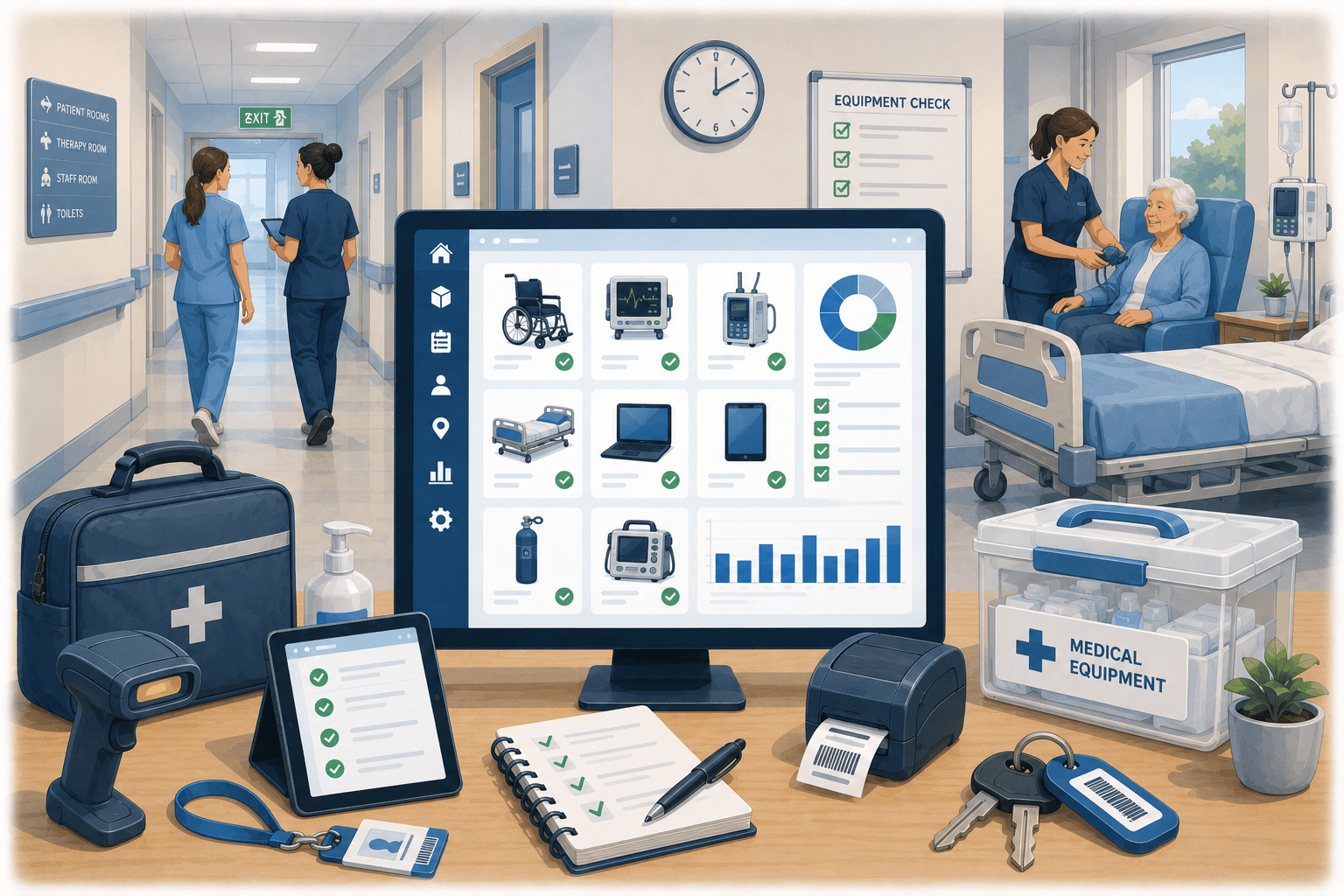
Hospitals, clinics, and care homes run on equipment. Mobility aids, monitoring devices, diagnostic tools, medication trolleys, keys to drug cabinets and storerooms. All of it needs to be where it's supposed to be, in working order, and accounted for at any given moment.
That's a tall order in an environment where staff are already stretched. Asset tracking tends to fall to whoever has a spare moment, which usually means it doesn't happen consistently. A clipboard at the nurses' station, a logbook by the door, a verbal handover between shifts. It's not that staff don't care. It's that the systems available to them simply aren't built for how fast and how busy these environments actually are.
Equipment that can't afford to go missing
In most industries, a missing piece of equipment is an inconvenience. In healthcare and care settings, it can directly affect patient care. A monitoring device that can't be located, a mobility aid that's been moved to another ward without anyone updating a record, a piece of diagnostic equipment that's due for servicing but nobody can confirm where it currently is. Each of these creates delay at exactly the moment delay matters most.
A clear, real-time record of where equipment is and who last had it removes a lot of that friction. Staff aren't searching corridors or calling round other departments. They're checking a system that tells them straight away.
Key control in sensitive areas
Keys to medication cabinets, treatment rooms, and storage areas carry a level of risk that goes well beyond the cost of replacing them. Knowing exactly who has access, when, and to what, isn't just good practice. In regulated healthcare environments it's often a requirement.
A proper key and security asset tracking system gives you a timestamped history of every key movement, so access can be reviewed and accounted for whenever it's needed, rather than relying on staff memory or a paper sign-out sheet that's easy to forget.
Compliance isn't optional in this sector
Healthcare and care providers operate under significant regulatory scrutiny. Inspectors want to see that equipment is maintained, that access is controlled, and that there's a clear record behind both. Trying to assemble that picture manually, often after the fact, is stressful and time consuming.
When every asset movement, maintenance check, and key sign-out is logged automatically, audit preparation stops being a fire drill. The records already exist. Our guide to asset compliance and auditing goes into more detail on how this works in practice across regulated sectors.
Devices and IT equipment
Beyond medical equipment, healthcare settings also manage a growing amount of IT hardware. Tablets used for patient records, handheld scanners, laptops shared between staff. These devices move constantly between wards, departments, and shifts, and they're just as easy to lose track of as anything else.
Our IT asset tracking page covers how to keep visibility over devices like these, including who's responsible for them and when they're due for review or replacement.
Built for staff who don't have time to spare
Any system introduced into a healthcare setting has to be quick to use, or it simply won't get used. AssetControl.cloud is designed around fast check-in and check-out, so logging a movement takes seconds rather than minutes. It works across facilities and shared equipment too, giving you one consistent system instead of several disconnected processes.
If your team is relying on paper logs or memory to keep track of equipment and keys, it's worth seeing what a dedicated system looks like in a busy clinical environment. Book a free demo and we'll talk through how it would work for your setting, or view our pricing to see what's included. You can also grab our free asset tracking checklist if you want a simple starting point first.