Knowing Where Your Assets Are Is Only Half the Job
Knowing where a piece of equipment is can solve a lot of problems.
But there is another question that matters just as much:
Is it actually ready to use?
A laptop might be sitting exactly where your system says it is. A piece of equipment might have been returned on time. A vehicle key might be accounted for.
None of that tells you whether the equipment is due a service, has an unresolved fault or has already undergone several repairs.
That is why effective asset management needs to go further than simply recording where something is.
An asset can be accounted for and still be unavailable
Traditional asset registers tend to focus on the basics:
- What do we own?
- Where is it?
- Who has it?
- When is it coming back?
Those are important questions, but they do not give you the complete picture.
Imagine a member of staff needs a particular piece of equipment for a job. They locate it, collect it and only then discover it is overdue for servicing.
Now somebody needs to find an alternative, rearrange the work and investigate when the equipment should have been maintained.
Technically, the asset was never lost.
Operationally, though, it might as well have been.
Maintenance information often ends up somewhere else
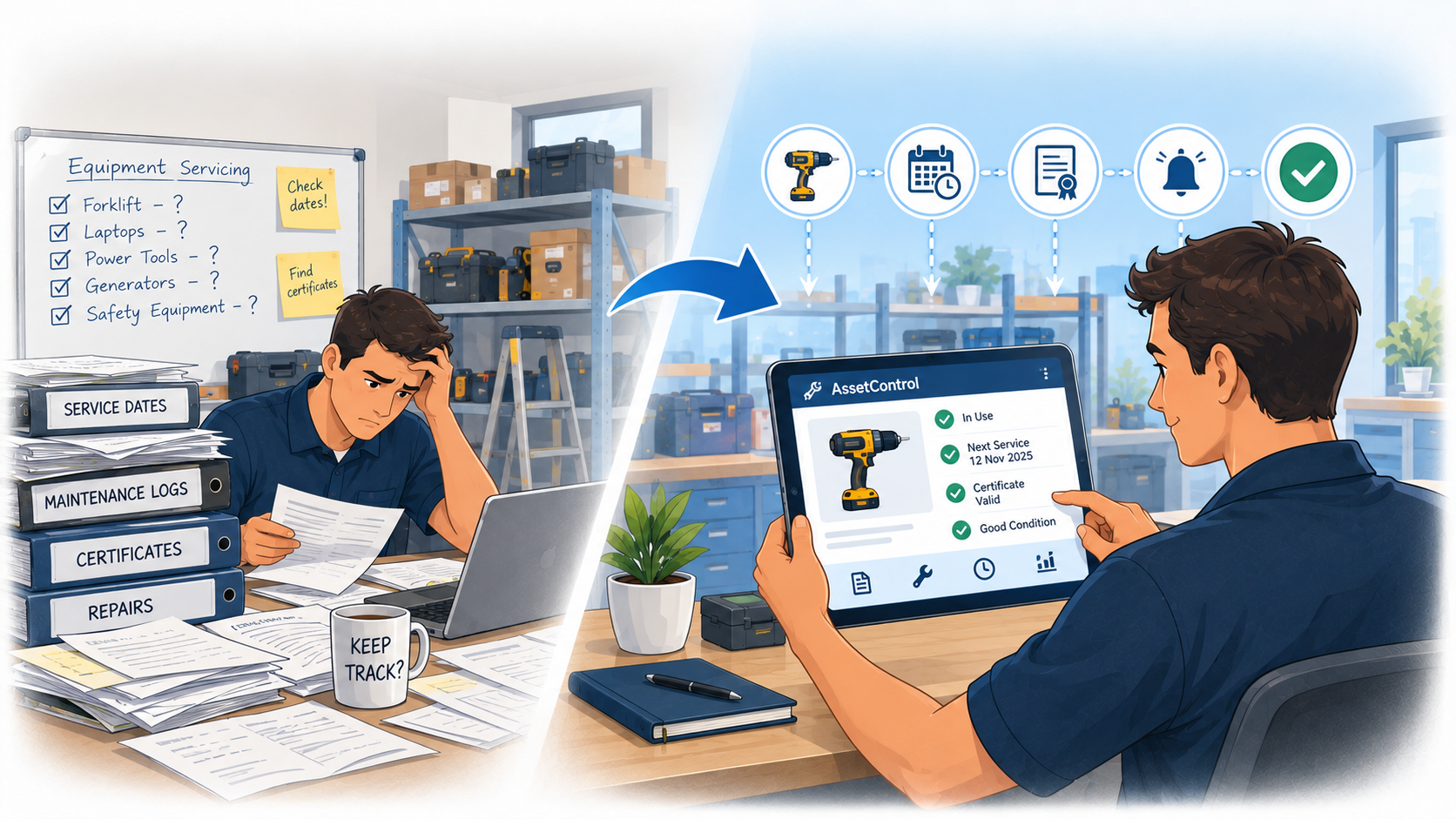
One of the biggest problems is that asset information and maintenance information are often managed separately.
The asset register might be in one spreadsheet.
Service dates could be kept in another.
Certificates might be sitting in a shared folder.
Repair requests could be buried in emails.
Supplier information might only be known by one person.
Each individual system might work, but somebody has to piece everything together whenever they need the full history of an asset.
That becomes increasingly difficult as the number of assets, staff and locations grows.
Your asset record should tell a story
A useful asset record should do more than confirm that an item exists.
It should help you understand what has happened throughout that asset's working life.
For example:
- When was it purchased?
- Where is it currently located?
- Who is responsible for it?
- When was it last serviced?
- When is the next service due?
- Has it previously developed faults?
- What maintenance work has been completed?
- Are there certificates or documents associated with it?
- Is there currently an open maintenance request?
When that information is connected, teams can make better decisions without searching across several different systems.
Planned maintenance beats unexpected downtime
Maintenance is much easier to deal with when you know it is coming.
If a service requirement is recorded against an asset in advance, teams can plan around it.
The equipment can be made available at the right time, alternative equipment can be arranged if necessary, and the work can be scheduled before a missed service becomes an operational problem.
Compare that with discovering a problem when somebody actually needs the asset.
One approach is planned.
The other is reactive.
And reactive maintenance tends to mean more disruption, more chasing and more pressure on the people trying to solve the problem.
Alerts can remove the need to remember everything
Even a well-maintained spreadsheet has one major weakness:
Somebody still has to remember to check it.
Important dates can sit perfectly recorded in a document while nobody notices that they are approaching.
Automatic reminders can help teams stay on top of upcoming servicing and other important dates before they become a problem.
The information stops being something you simply record and becomes something you can act on.
Maintenance history helps with bigger decisions too
A good maintenance record is not only useful for organising the next service.
Over time, it can help businesses understand whether an asset is still worth keeping.
If a piece of equipment has needed repeated repairs, has become increasingly unreliable or is regularly unavailable, having its history in one place gives teams far more context when deciding whether to repair or replace it.
Without that history, decisions can end up being based on whatever somebody happens to remember.
With it, teams can look at what has actually happened throughout the asset's lifecycle.
Bringing maintenance and asset tracking together
AssetControl Cloud brings asset records, users, locations, checkouts and maintenance information together in one place.
Teams can keep servicing requirements, maintenance history and supporting records connected to the asset they relate to.
This gives a much clearer picture than simply asking:
“Where is it?”
Instead, teams can see:
“Where is it, who is responsible for it, what has happened to it and is it ready to use?”
Asset management is really about availability
An asset only delivers value when your business can actually use it.
Knowing where equipment is matters.
Knowing who has it matters.
But knowing whether it is available, maintained and ready for its next job is what turns an asset register into something genuinely useful for everyday operations.
If your asset records, service dates and maintenance history are currently spread across spreadsheets, folders and inboxes, bringing that information together is a good place to start.
See how AssetControl Cloud can help you keep track of your assets and the information that matters throughout their lifecycle.