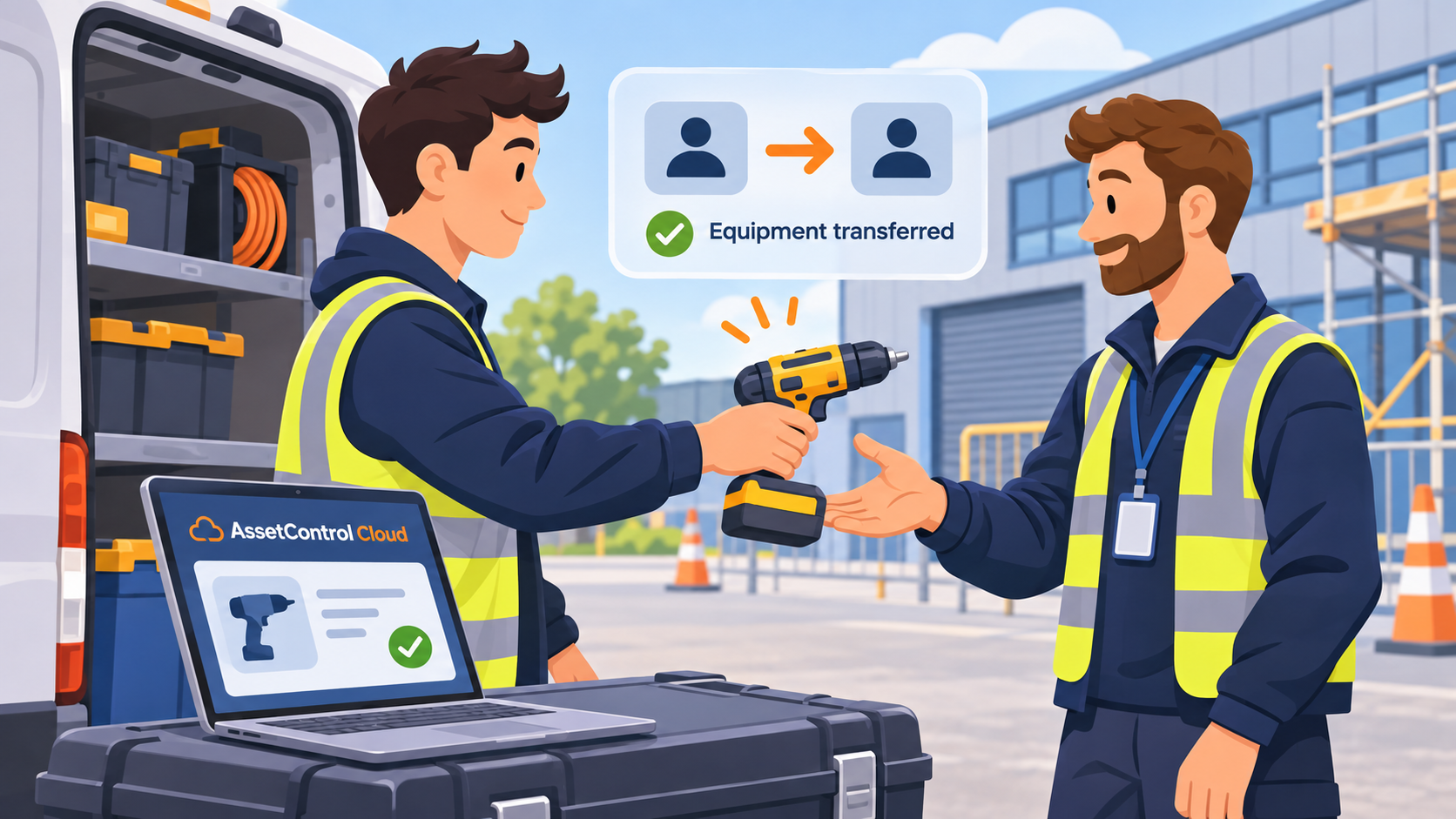
Why equipment shouldn't have to return to stores just to change hands.
Picture this.
An engineer collects a piece of equipment from stores on Monday morning.
By Wednesday, another engineer needs the same item for a different job. Rather than travelling back to stores, the two engineers meet, hand over the equipment and carry on working.
It's a perfectly sensible way to operate.
The problem? The equipment register might still show the original engineer as the person responsible.
This is where tracking equipment between engineers becomes important, particularly for businesses with teams working across different locations.
When Equipment Moves, the Records Need to Move Too
In engineering, facilities management and construction, equipment rarely stays in one place.
Tools, testing equipment, access equipment and specialist devices regularly move between employees, vehicles and sites.
Not every handover involves a trip back to the equipment store.
An engineer might pass a cable tester to a colleague finishing another job. A maintenance technician might hand over a specialist tool before moving to a different site.
These everyday transfers are often convenient and necessary.
But when they're not recorded, businesses can quickly lose track of who is actually responsible for their equipment.
Why Informal Equipment Handovers Create Problems
A quick conversation or WhatsApp message might be enough to arrange a handover.
But is it enough to maintain an accurate asset register?
Consider what happens when somebody needs the equipment again a week later.
They check the records, contact the engineer listed as responsible and discover that the item was passed to somebody else days ago.
Now the search starts again.
This can lead to:
- Time wasted contacting multiple engineers to locate equipment.
- Incorrect records showing who currently holds an asset.
- Confusion over equipment that's overdue for return.
- Difficulty reviewing previous movements or investigating missing items.
- Unnecessary replacement purchases when equipment cannot be located.
The equipment itself hasn't necessarily been lost. The record of its movements has simply stopped being accurate.
A Simpler Way to Track Equipment Transfers
A reliable equipment tracking process doesn't need to make everyday work more complicated.
It just needs to capture each change of responsibility.
Here's what that looks like in practice.
1. Give Each Asset a Unique Identity
Each piece of equipment should have its own asset record and unique identifier.
QR codes or barcodes can be attached to physical items, allowing staff to identify the correct equipment without manually searching through a register.
2. Record Who Currently Holds the Equipment
Whenever an item is checked out, record which employee is responsible for it.
That gives the team a clear starting point when equipment needs to be found, transferred or returned.
3. Record Transfers Directly Between Engineers
If an engineer passes equipment directly to a colleague, the record should reflect that handover.
There shouldn't necessarily be a requirement to return the item to a central store before it can be assigned to somebody else.
The important thing is that responsibility transfers alongside the equipment.
4. Keep a History of Each Handover
Knowing who currently holds an asset is useful.
Knowing who previously held it, when it moved and how it reached its current holder can be just as valuable.
A clear movement history makes it easier to investigate discrepancies and understand how equipment has been used across the business.
How AssetControl Cloud Supports Equipment Transfers
AssetControl Cloud helps businesses manage equipment, physical keys and other assets across employees and locations.
Instead of relying on separate spreadsheets or informal messages, teams can maintain individual asset records and record equipment movements within one system.
AssetControl Cloud supports direct handovers between users, allowing equipment to be transferred to another person without physically returning it to stores first.
Authorised users can record these handovers, keeping the current holder and movement history connected to the asset.
QR code and barcode labels can also help staff quickly identify equipment. The system can be accessed through a modern mobile web browser, without requiring a separate app download for the web workflow.
The result is a clearer record of who is responsible for equipment as it moves between team members.
Explore AssetControl's check-in and check-out features.
Better Tracking Without Slowing Down Engineers
An equipment tracking process should support how people actually work.
Engineers need access to the right tools and equipment, often at short notice and across multiple sites.
Making every item return to stores before another employee can use it may introduce unnecessary journeys and delays.
But allowing equipment to change hands without updating records creates a different set of problems.
The goal is to find a balance: straightforward equipment handovers supported by accurate, accessible records.
Keep Equipment Moving. Keep Responsibility Clear.
Equipment will always move between employees, departments and locations.
That isn't the problem.
The problem starts when nobody can confidently say who has it.
By recording equipment checkouts, transfers and returns, businesses can maintain better visibility without creating unnecessary administration for their teams.
Want to see how AssetControl Cloud handles equipment handovers?
Explore AssetControl Cloud and discover a simpler way to manage shared equipment across your business.